Saturday, November 10, 2012

Orchids and stuff....

Its become a lot harder for me to get a new bird close to home of late and while birding will always remain the number one passion (aside from Simone of course) I have recently started to develop a more than passing interest in native orchids. I have always had a bit of an interest in them - I can generally seperate an orchid from a lily or the like - but it now seems to be evolving into something a little more. Certainly there has been a few times lately where I have left the binoculars at home and spent much of my time staring at the ground... I still bird while doing this, but almost purely by ear, and that is a rather cathartic experience. Its also opened up a whole new field of identification and one that is just a bit challenging, particularly as for a lot of the year an Australian native orchid might be at best a single or double leaf poking out of the forest floor. At the moment my pics are just with a standard 50mm nikon lens hand held but I can see a macro lens in my near future....

Baluk Willam Reserve

This is the reserve that really got me back interested in orchids.... I have spent much of the past 15 years birding around South-east Melbourne and I cant understand why I had never heard of this place before... it was only a random google search that put me onto it. It is a relatively small reserve in Belgrave South that has an amazing 80-90 species of orchid recorded, although a number of these are historical records. Its also not a bad birding place and I have recorded such nice outer suburban birds as Painted Button-quail, Brush Cuckoo and Satin Flycatcher as well as a Powerful Owl feather.... must get back and flash the spotlight around sometime. On my first visit in mid October I found around a dozen species of flowering orchid and on subsequent visits I have now found over twenty. Im looking forward to revisting over the next 12 months as I have also found a variety of "orchid leaves" that are not yet flowering... there is also a good half of the reserve still as yet unexplored.

Just a few "record shots" - ID is my best guess and am happy to be corrected. :-)

Maroonhood

Waxlip Orchid
Purplish Beard Orchid (a bit past its best)
Notched Onion Orchid (best guess)
Large Bird Orchid
Black-tongue Caladenia
Rabbit Ears (ok I cheated with this one.... its from the Brisbane Ranges)
 
 
Plenty more of these to come....


Friday, August 17, 2012

In search of the Dorothy Grasswren - Mt Isa - Bladensburg - Boodjamulla Trip Report

(Better late than never)


I remember many years ago reading Brigadier Hugh Officer's account of searching for the Dorothy Grasswren – a species that had only recently been rediscovered in the early 1970’s – it certainly stirred the imagination and daydreams of birds I thought I would never get to see. When mates Tim Dolby and Greg Oakley discussed a trip to Mt Isa, I was very keen. Over a number of months we put together plans and after receiving permission from the boss, booked some flights and a car. With Qantas flying daily to Mt Isa from Brisbane, return flights cost around $900. We hired an X-trail through Budget which was adquate for what we needed - cost around $1200 total for the week when extra km were factored in. The key species we were after no matter what were the two grasswrens, Carpentatrian and Kalkadoon which are not really found easily anywhere else - after that we had vague plans about heading to Bladensburg NP and Lawn Hill as time permitted.

Crimson Finch - Greg Oakley

Got up at god-awful o'clock for a 6 am flight to Brisbane and then on to Mt Isa. Having a window seat as we crossed the expanse of the Queensland outback I could see that most watercourses seemed to have at least a little water in them so was hopeful that conditions were good. As we flew into Mt Isa I looked rather hopefully out the window for a Kalkadoon Grasswren amongst the spinifex covered hills. My initial impression of Mt Isa reminded me quite a bit of Alice Springs and that it was certainly warmer than late autumn in Melbourne.


Double-barred Finch - Greg Oakley

Headed straight out to the famous Mica Creek site on the Diamantina Development Road to look for the Kalkadoon Grasswren despite it being the heat of the day. We worked up the creekline near the rusty car without much success - there was quite a bit of wind and it made listening for grasswrens difficult. We of course had brought no drinks so decided to head back to town to cool down a bit but upon returning to the creek ran into quite a hot spot of birds where we finally got the trip list kicking with birds like Red-winged Parrot, Grey-headed, Grey-front and Black-chinned Honeyeaters and a favorite of mine - a pair of Black-tailed Treecreeper.

Had some welcome refreshments in Mt Isa and then headed to the water tanks at the edge of town at the end of Pamela Road to look for Kalkadoons. On the way we saw my first ever Spotted Bowerbirds which turned out to be a common bird around town. We straight away heard grasswrens at the base of the first tank but they evaded us so we worked up the valley between the tanks occasionally getting excited by Spinifexbirds - this was a bird I really had to work for in Central Australia but here they were distracting from the main target - I still maintain they are the most boring bird in Australia. Reached the top of the gully and then we heard grasswrens back in the direction we had just came - after a few anxious moments we got onto a nice pair of Kalkadoon Grasswrens! First afternoon and one of the main targets out of the way. They went about their business and were not interested in any playback or pishing what so ever. The similarities with the Dusky from which they were split is quite evident and really not surprising as the Mt Isa region bares a strong resemblance to the MacDonnells near Alice. Checked in to the Moondarra Caravan Park and had a few quiet ales to celebrate...
Long-tailed Finch - Greg Oakley

With the expansion of the mining industry around Mt Isa the caravan parks are no longer tourist oriented as was hammered home to us around 4 am when all the miners got up to go to work.... On the return journey when we politely enquired about maybe finding a quieter place to camp we were politely told if we didnt like it to fuck off :-) It did mean we were on the road early and headed out towards Lake Moondarra which is a large manmade lake around 20 km out of Mt Isa. On the way there, there is a glorious large area of wetland with birds like Green Pygmy-goose, Jacanas and Whistling-ducks to remind us southerners that we weren't at the WTP. Finches were next on the agenda with some lovely Long-tails in amongst the more common Zebra's and Double-bars as well as the lovely Golden-backed race of the Black-chinned Honeyeater. At the lake itself we failed to track down some elusive mannikins disappearing into the scrub which were probably Pictorellas but a good compensation was a number of lovely Painted Finches - only my second sighting. While we wanted to continue to explore this area, there was a bigger prize on offer - we had second grasswren to find.

So we headed out to the famous McNamara Road site for the Carpentarian Grasswren - the habitat was looking fantastic and we passed quite a bit of promising looking habitat. We arrived at the famous cairn - shown above - and started searching. It was quite windy which made grasswren searching less than ideal. As we worked our way up a dry creekbed, Greg and Tim caught a sighting of one but I missed it... gutted! Continued to work the area but with no luck. We tried a number of likely spots and possibly heard grasswrens but were mostly just kicking Spinifexbirds out of the way. A couple of flushed Button-quail provided some excitement, the one I got bins on was a Little but another had rustier flanks.

Eventually we stopped for some lunch under the questionable shade of a spindly eucalypt around 2km south of the cairn site and plotted our next move. We decided to cover a lot more ground moving quickly and relying on our decent hearing to pick up grasswrens. After 40 minutes of walking and kicking more Spinifexbirds out of the way we heard unmistakable grasswren calls and quickly got onto a group of Carpentarian Grasswrens! My first binocular view of a male calling with head thrown back is one of my favourite birding moments! This is a bird that the field guides do not do justice. We spent quite a bit of time with this group which may have numbered up to 5 birds as Tim and Greg tried to get photos. On the way back to the car we flushed another grasswren - the birds were getting easy.
Carpentarian Grasswren - Greg Oakley

From McNamara Road we headed back through Mt Isa and headed out towards Cloncurry. We decided to camp at the Chinaman Creek Dam which was a lovely place with Purple-necked Rock wallabies hopping around the campsite. Here we met up with Tim Faulkner, Scott Ryan and John Weigel who were in the middle of a manic dash across the country and back ticking off as many birds as possible for John's Big Year. Was great to share some info with these guys as well as a couple of drinks. Check out http://www.birdingfordevils.com.au/ for more info on John's odyssey.
The road between Cloncurry and Winton is rather flat and featureless aside from the odd Brolga and Bustard. Somewhere along this road we clocked up our 3,000,001th Black Kite. At Winton we checked out the local shit pits which have quite a bird list but was quite uneventful when we were there with just a couple of mouldy looking teal.


Bladensburg NP is a relatively short drive south of Winton on good roads that are obviously well used on the grey nomad route. As we entered the park there were large flocks of Zebra Finches wherever there was water - we spent some time looking through them but all we found were more Zebbies. Out in the open country the eremophila was flowering and had attracted good numbers of  Black Honeyeaters and Crimson Chats.  We stayed at the pleasant Bough Shed hole campsite which had some nice birds around including some very approachable Cloncurry Ringnecks.
Rose early to the coldest morning of the trip, I even slipped on a light fleece top as we packed up and headed out of the park, stopping to check out a few groups of finches along the way. A bonus was a pair of Ground Cuckoo-shrikes on the road out of the park, only my second sighting of this species, they did not stick around long however. As we left the park I certainly had the nagging feeling that one night certainly was not enough time to do Bladensburg justice. Lark Quarry is about 120 km south of Bladensburg on a pretty good dirt road through lightly stocked country which is probably in as good a condition right now as it has been in a long while. Emu, bustards and the odd raptor provided distraction until we arrived at the turnoff to Lark Quarry where we stared up hopefully at the radio tower in hope of the Grey Falcons which sometimes roost there. No falcons, but there was a nest which we later found out had been used by the Grey Falcons to raise a couple of chicks the previous year…. Getting closer! Our targets here were Hall’s Babbler and race “rowleyi” of the Striated Grasswren. We found the babblers quite quickly in mulga near the airstrip which I was pretty happy about as it was the last of the Aussie babblers I “needed” The grasswren proved to be more problematic as there was now quite a strong breeze which made listening for squeaks somewhat difficult. Eventually we admitted defeat here on the grasswren although I did get a brief look at the Rufous-crowned Emu-wren. We checked out the dinosaur stampede with a quick tour which was certainly worth the price of admission. The guide said he regularly sees Grey Falcon between Lark Quarry and the turnoff to Opalton so when we saw a pale falcon perched distantly in a tree we thought we were onto something but it turned out to just be another Brown. We ended up missing the turnoff to Opalton and by the time we realised it would have been another couple of hundred km on the day’s trip. Considering we needed to be in Cloncurry that evening it was decided that the grasswren will have to wait til next time – I expect it will be split next week sometime. The drive from Winton to Cloncurry was punctuated by many bustard, emu, brolga and some nice raptors like Spotted Harrier.

We stayed at the caravan park on the eastern edge of Cloncurry which just so happened to be right where trucks slow down to take the heavy vehicle bypass…. So all night was a constant procession of air brakes and rumbling engines that not even a few beers could blot out. Headed out early, north via The Bourke and Wills Roadhouse then west to Gregory Downs and Lawn Hill. We passed through vast areas of tropical savannah and flood plain with large flocks of Cockatiel, Budgies, Crimson Chats and the odd Black-necked Stork. We stopped at the Leichardt River which was a very nice spot, made difficult by the typical Queensland practice of blocking access to some of their most beautiful sites. Here I got my first Yellow-tinted Honeyeater which proved to be a common bird throughout this area.

Yellow-tinted Honeyeater - Greg Oakley

At a creek crossing on the way into Lawn Hill we found a brilliant little finch drinking spot, so we set up some chairs and watched a steady procession of Double-bars, Long-tails, Zebbies and eventually a lovely pair of Pictorella Mannikins which was a great new bird for all of us and gave Greg the full suite of Australian finches…. Celebrated by cracking open a beer while we watched still more birds come in – doves and Brown Quail. Eventually pulled ourselves away from this great site and booked what was probably the last site in the campground at Lawn Hill NP – the place was packed with grey nomads in various states of decomposition. There were some great birds in the campsite itself with Buff-sided Robins everywhere and a lovely pair of Northern Rosellas sitting up nicely. Decided to go straight away for a walk and worry about the tents later and was soon amazed by the tall trees in the oasis by the river. Climbed the Island stack and soon had great views of Sandstone Shrike-thrushes near the top – I had spent a fair bit of time looking for both this bird and the robin in the Northern Territory a couple of years back and here I was ticking both within minutes of arriving here. The Island Stack is worth climbing as you get a great view across the canopy where Great Bowerbirds fly around like fruit pigeons. Walking back towards the camp I had vague thoughts of leaving the Lilac-crowned Fairy-wren to “tick” tomorrow but the birds had other ideas as several wandered into my binocular view – even though they were all in eclipse plumage, they are still a great bird – nothing fairy about it at all.


Buff-sided Robin - Greg Oakley

Four ticks in a day and I thought the day couldn’t get any better, so I climbed the escarpment south of the campground to try and find a view of the sunset. Settling back on a rock, my attention was drawn to a grey raptor gliding across the campground – fumbling with the binoculars I had great views as the bird burst into fast falcon hunting flight then stooping not once but twice at tremendous speed. Detailed notes are available if anyone is interested – but I had my first Grey Falcon under the belt, fantastic bird! Amazingly there was full mobile reception from this point so I googled Tim D’s mobile and called him from the escarpment top to tell him to keep an eye skyward! Was quite amused to see a Brown Goshawk cruise through the canopy and give a cockie a love tap on the shoulder – which caused the cockatoo great indignation! Tim D cooked a great curry dinner as we sat back and had a few quiet ones and were serenaded by the resident Barking Owls who put on quite a show.

Sandstone Shrike-thrush - Greg Oakley
Up early, we climbed the same escarpment in the hope that the Grey Falcon would cruise by again but we had to settle for Sandstone Shrike-thrushes hopping around our feet while squadrons of Budgies zipped past and the first Channel-billed Cuckoos for the trip floated through the canopy below. Wandered onwards until we got to Indarri Falls – this really is a little slice of heaven and we jumped straight in for a swim which was perfect. Wandered up the gorge seeing more fairy-wrens and robins as well as Rock Ringtail scat amongst the fruiting figs – will have to come back with a spotlight sometime. Eventually wandered back to camp and headed to Adels Grove for a cool drink and then out to the finch drinking site again. More finches again including Crimson, Long-tailed and two more Pictorellas (probably the same pair) as well as the first Pheasant Coucal and White-throated Honeyeaters of the trip and a particularly out of place Black-necked Stork standing guard over a puddle the size of a dining table. That night we had a few beers and the set menu at Adels Grove (the choices were chops or chops) and were entertained by a pair of travelling minstrels.

The trip back to Mt Isa was a little hairy as the road wasn’t great and due to a flat tyre at Adels Grove we now had no spare. More Brolgas and Bustards were of interest but the highlight was a lovely Black-headed Python crossing the road. I was quite interested in visiting the Riversleigh D site but it was rather underwhelming – I gather the good stuff is probably sitting in museum storerooms somewhere. There were a couple of minor crossing of the Gregory River which may have stretched the terms of the hire car agreement somewhat – each of these were lovely oasis and probably would have yielded some good birds with more time.


Back in Mt Isa, against our better judgement we booked another night at the Moondarra caravan park – this time the price was only 1/3rd the first night and did what any self-respecting birders would do in the middle of the day – headed for the shit pits. Mt Isa Sewage Works do have a good birding reputation and while we didn’t see anything extraordinary there were the only Red-kneed Dotterels, Pink-eared Duck and Black-tailed Native-hens of the trip. Not quite sure what the deal is for birder access, but the gate was wide open and no one was around so we wandered in and checked out the ponds. We bounced out to the far side of Lake Moondarra on the vague hope of a Yellow Chat or a rare wader but it was the wrong season. This was a great wetland area that looked like it would be fantastic in summer. Highlights included good numbers of hobbies zipping around catching dragonflies all along the lake edge – sometimes coming within a few meters of us, Glossy Ibis and both Gull-billed and Caspian terns. As evening approached we went back to where we had seen Painted Finch earlier in the trip but they were not around, however we got great views of a Purple-necked Rock-wallaby watching us from its cliff top hideaway. Had a shower then out to taste Mt Isa nightlife where the beer is cheap and plentiful, must be how they keep the miners happy.


The last morning was spent cleaning the hire car and a quick trip out to Lake Moondarra where a mouldy looking Straw-necked Ibis gave us the last addition to the trip list. All in all we had a fantastic birding week with 169 species recorded of which 11 were ticks for me. My first glimpse of the Carpentarian Grasswren standing with its head thrown back, calling its heart out will long stick with me as one of my favourite birding memories. I will have to go back as I still didn’t get a glimpse of the Diamantina River… We drove around 2500 km with places like Lawn Hill, Bladensburg and Lake Moondarra stand outs – bird lists for most sites have been entered into www.eremaea.com Special thanks to Tim D and Greg for being great birding companions and putting up with me. Tim with his boundless knowledge of sites and locations and Greg for use of his bird photos. And finally thanks to Simone and Lucas for letting me go!! xx


Monday, April 16, 2012

BIRDLIFE MELBOURNE EASTER CAMPOUT - WYPERFELD


Over Easter 2012 a number of Birdlife Melbourne members headed to Wyperfeld for a long weekend of birding. To break the long drive, members stopped in a number of places on the way up like Little Desert, Lake Tyrrell and Gama seeing a range of great species like Malleefowl, Elegant Parrot, Rufous Fieldwren and Black-faced Woodswallow. On arrival at the Wonga campground the wind sprung up to gale force and it was quite amusing to watch other people’s tents cartwheeling through the campsite. As the weather was hardly conducive to bush birding the group went for a drive and some members were rewarded with a Malleefowl crossing the Dattuck track and small groups of Regent Parrots particularly near the Lignum Track. The camp kitchen was quite useful considering the crazy wind - despite the old coot who called "bullshit" on every bird we had seen that day... he had however seen blue wrens so who were we to doubt his prowess?

The next day dawned beautiful and still, a perfect day for birding in the mallee. The group hit the Discovery Walk and found a suite of good birds – Redthroat, Southern Scrub-Robin and an elusive Chestnut Quail-thrush but probably the highlight was the gorgeous blue skies and the fact I was back birding in the mallee again! A midday visit to the Desert Track kept the honeyeater count climbing with Striped and Tawny-crowned as well as the first shy Gilbert’s Whistler. An evening walk along the Dattuck Track had heaps of White-fronted Honeyeaters and the first visible Shy Heathwrens as well as scads of White-browed Woodswallows overhead. That night after a couple?? (LOL!) of quiet drinks we were serenaded by the dulcet tones of Boobooks and the screams of Barn Owls.

Sunday was a visit to Northern Wyperfeld – first target was White-browed Treecreeper which was found quiet easily in some of the lovely Callitris forest along the Meridian Track - this was a tick for me after dipping at a number of sure fire spots in the past. Leaving some of the more keen photographic people, the rest of the group bounced around the north of the park where a number of group of Major-Mitchell’s Cockatoo’s were a highlight.  I tested my iron guts at the bain-marie in Hopetoun with a so called "meat pastie" that was not yet 3 weeks old and 2 rubbery potato cakes and came through with flying colours - quite amazing the ability of a cold beer to kill any bacterial goodness. A drop in at Lake Albacutya on the way back revealed it is still a lake in name only – none of the recent rains has reached the dusty lake bed - a species list of four revealed its current standing as one of the meccas of Australian Birding.

Early morning birding on the Monday before the long drive back to Melbourne - I had Shy Heathwrens almost bouncing on my toes - they are certainly suckers for the evils of playback. A number of members had an exploratory drive through Wathe Flora and Fauna Reserve on the way back, but the deep sand made it an exciting trip with little birding of note. All in all a very successful trip with most target species found. Keep an eye out for further campouts planned for later this year - you really should come birding on my outings - you will see birds ;-)


Friday, June 17, 2011

Alice Springs Birding Trip Report

From the 8th of June I went on what was meant to be a five day birding trip around Alice Springs. Thanks to a certain Chilean volcano the trip was extended by an extra few days. Joining me on the trip was Kris Reinertsen my future father-in-law who has a particular interest in plants, aboriginal culture as well as all things that wiggle, fly or walk. As our first child is due at the start of August it was a bit of a last birding hurrah before my life changes (for the better of course) Thanks to Simone for letting me go, she is a bit of alright!!! Special thanks must also go to Tim Dolby for his detailed and comprehensive notes on the area.

We stayed most nights at the YHA in Alice Springs which was adequate for our needs. Hired a Nissan Patrol from Apollo which was perfect as well as having unlimited kilometers at a competitive price. The staff there were also very helpful and I certainly will be using them again! http://www.apollocamper.com/
If you are looking for something to eat then you can go past Alice's Vietnamese Restaurant near the airport - Excellent!

I had read a lot of trip reports from the last couple of years and I think the conditions were quite different to what I was expecting. There was plenty of vegetation but little flowering, so the rarer, nomadic honeyeaters were absent. We also saw only what I would consider low numbers of Diamond Dove and Zebra Finch compared to reports from last year and only a single flock of Budgies. Black-faced Woodswallow were the only woodswallows seen but were very common. Also surprising was the lack of roadkill, only 3 dead kangaroos seen in 2200 km of driving, I think the sheer amount of fodder around means they dont have to forage on the roadside at the moment. This also meant that large raptors were quite scarce, although smaller raptors like Brown Falcon and Kestrel were extremely common.


Following is a summary of most of the main sites visited.

Olive Pink Botanical Gardens - after picking up the hire car and doing a bit of shopping, this was the first site we visited. Upon stepping out of the car I could hear a Western Bowerbird which turned out to be a male trying so seduce a mate at his bower. Spent quite a bit of time walking around picking up Diamond Dove and Little Crow amongst others. There were quite a few Euro's on the hill above. A further visit didn't reveal much else aside from a young Western Gerygone which had me scratching my head for a moment. I can highly recommend the chickpea nachos from the canteen!


Santa Teresa Road - Later on the first day we made the trip to the "tyre in the pole" site but the weather was very inclement - driving rain and wind. The road became quite bad in places and was glad to have the 4wd, having to lock the hubs when we started sliding all over the clay road. While most of the time the road might be ok in a 2wd there is no way it should be attempted when wet or shortly after rain. Walked around for a couple of hours in the wind and rain before giving up, was getting in serious risk of hypothermia! We returned a couple of days later and quickly found several groups of Rufous-crowned Emu-wrens in the spinifex gullies north of the pole. Also heard a Spinifexbird here but could not track it down. Other birds of note included Red-backed Kingfishers on the wires, plenty of Mulga Parrots and a single White-backed Swallow.


Simpson's Gap - woke up on the second morning and headed to Simpson's Gap, arriving just before dawn - we saw an Owlet-nightjar flying off the road. Once again the weather was quite foul, spent several hours at the gap but hardly heard or saw a bird - at least we had the place to ourselves. After a hot cup of tea we did a couple of the short walks but again birds were in short supply. The numbers of Brown Quail and Little Button-quail were impressive as was a young Brown Goshawk who kept following us, peering down perhaps qanting us to flush a quail. We did return later in the trip to do the Cassia Hill walk which was quiet aside from a couple of Dusky Grasswrens at the top of the hill.


Trephina Gorge - headed out to Trephina Gorge and as we did the weather started to improve. The river at Trephina was flowing quite well so there was no real chance of birds coming into drink at any waterholes but it did mean there were quite a few Black-fronted Dotterels around the edges. Had lunch which we shared with the local Peaceful Doves and Grey Shrike-thrushes which both had a taste for cheese. Did the gorge walk which involved a bit of wading and tracked down quite a number of very approachable Dusky Grasswrens which capered around my feet for some minutes. This is a great place and would love to come back and camp sometime. Driving back to Alice, just past the turnoff to Trephina, we flushed a couple of small parrots with light blue backs from the side of the road, BOURKE'S PARROTS! Slammed on the brakes and jumped out and were able to observe a pair foraging on the road side which hardly seemed concerned by our presence. It was at this stage of the trip that I finally felt I had my birding mojo back.


Old Telegraph Station - Back in Alice it was time to chase a mammal tick. Searching around the rocks above the Bradshaw Track we found good numbers of Euro and then finally a group of Black-flanked Rock-wallabies. These are very cute little buggers and quite approachable, I ended up going back a couple more times during the trip to "visit" them. As the big red gums along the Todd River are supposed to often hold Red-browed Pardalote I spent a lot of time walking between town and the station over several days with no luck. Did see plenty of Western Bowerbirds and even a couple of Buff-banded Rails.


Kunoth Bore - Got up early and headed for the mythical Kunoth Bore area. Not much on the drive there so drove down to the eremophila patch and started there. Very little erempophila in flower so just the usual Singing and Spiny-cheeked Honeyeaters as well as many Little Button-quail.  Then started in the mulga across the road and worked my way back towards the dam itself. After sifting through many Chestnut-rumped and Inland Thornbills I eventually came across a pair of Slaty-backed Thornbills. Had lunch at the dam itself where there were 8 Hardhead looking a little out of place. Ended up visiting again later in the trip where we found an Australian Bustard male on the main road opposite the windmills, Kris ended up seeing what was probably the same bird again near the dam. Bush birds were similar although this time I had Crimson Chats and plenty more Slaty-backed Thornbills although they were still the least common of the four thornbill species in the area. Raptors were abundant including a Spotted Harrier and two Black-breasted Buzzards further down the Tanami Road.


Erldunda - drove down to the T&T site 21 km north of Erldunda arriving about 4:00 pm. As there were cows on the traditional west side of the road I decided to try the east side. Within 10 minutes I came across a mixed flock of Banded and Southern Whiteface and Crimon and Orange Chats! Three new birds in one flock, it has been sometime since I have seen that! According to C&B 2008, the Banded Whiteface was my 600th Aussie bird too. Also found a couple of groups of Bourke's Parrot and the odd Chiming Wedgebill which were quiet until I set one off by playing a tape. Also of note were our only flock of Budgerigar for the trip. Kris was particularly impressed by the site as he found large numbers of Aboriginal stone artifacts and tools. Searched quite hard in the morning for Cinnamon Quail-thrush and had to conclude they are either not in the area currently or are being extremely quiet. Stayed at the "resort" at Erldunda which was in the midst of a mouse plague... was quite amusing to watch them scurrying around the bar and kitchen area. A Major-Mitchell's Cockatoo was the most interesting bird here.

Ernest Giles Road - we drove this road to get across to Watarrka. It was quite cut up following the recent rains so a 4wd would definately be recommended. We passed some rocky hills just short of the Palmer River which I thought looked good for quail-thrush. Sure enough after 5 minutes of searching I heard their high pitched calls and soon managed to track down a couple of pairs of Cinnamon Quail-thrush which I was quite happy to see after missing them around Erldunda.


Watarrka - Watarrka was one of those places that if I knew we had the extra days, we would have stayed longer. As it was we only had a couple of hours so I just birded around the carpark and up the creek. This was very productive however with my first Painted Finches, Grey-headed Honeyeater and Spinifex Pigeons. I would recommend checking out the rock pool directly behind the carpark. The scenery too is spectacular!! Some nice raptors around as well, including Little Eagle and Peregrine Falcon.


Mereenie Loop - from King's Canyon resort we picked up a permit and drove the "famous" Mereenie Loop to Glen Helen. The road had recently been graded and was like a super highway! While we did stop for a few "toilet stops" the birds seemed to be very few and far between aside from the odd raptor. When we got to Glen Helen we discovered there was a folk festival on so no chance of accomodation. Made the long drive back to Alice in the dusk, seeing a number of dingos and Bush Stone-curlew but fortunately no larger animals.


Ormiston Gorge and Pound - Got up early on what we thought was going to be our last full day in Alice and headed to Ormiston, arriving just on dawn. Birded for a couple of hours in cold conditions at the patch of spinifex just past the turnoff looking for Spinifexbird which I did not find. I did hear Rufous-crowned Emu-wrens in a couple of places but they were wisely staying bedded down in the spinifex. Decided to try back here later in the day if necessary.    


Parked in the carpark, which has a resident Western Bowerbird, and headed off to do the Pound Walk. There were signs warning of a long cold swim at the end due to the water levels so we ended up doing half the walk and then returning. Almost immediately we started running into groups of Dusky Grasswrens as we climbed up the hill, almost kicking them out of the way in places. I would easily have seen 50 birds by the end of the walk and heard many more. As we got higher, Grey-headed Honeyeater became the common honeyeater in small flowering eucalypts. The scenery on this walk is outstanding and it is worth doing for this alone. Other birds on the walk in included Spinifex Pigeons and Little Button-quails. In the pound itself I left Kris to have a smoke and to take in the scenery at the pile of rocks while I went searching for more mature spinifex and the Spinifexbird. Crossed the creek which had a lot of water and the spinifex clumps became larger, in this area I quickly found a Spinifexbird which must be a contender for the most boring bird in Australia, it is dull, plain and skulking and its song is rather bland too. Still it gave me good views and I was a rather happy chap. Searched around the carpark and along the entrance road as well as a number of dry creek beds on the road back to Alice unsuccessfully for Red-browed Pardalote which became the theme for the next few days!


Ellery Big Hole and Ochre Pits - dropped in and did short walks at both these sites but not much of interest from a birding perspective aside from a few Hardhead at the big hole.

Standley Chasm - visited here early in the morning on the last full day and we were the first tourists here. From a scenery perspective this is well worth a visit but get here before the tour buses do! As Kris had a cup of coffee I birded down the entrance road and finally heard a Red-browed Pardalote calling from a ridgeline! I climbed up only to have a White-plumed Honeyeater chase a small bird back down to the road. Finally managed to get a good view of the bird and was very happy to finally get that one under the belt. It certainly supported my theory that they were keeping quiet due to harassment from the large numbers of WP honeyeaters everywhere! Also in the area were a number of Grey-headed Honeyeaters.


Around Alice - like any new town it was interesting to observe the behaviour of common town birds. Little and Torresian Crows, Ringnecks, Galahs and Little Corella's seemed to be everywhere. Unfortunately the only feral birds of the trip, Spotted Doves, appear to be on the increase and were quite common. On the last morning a Western Bowerbird was fossicking up and down Todd Mall, perhaps looking for a new trinket for its bower.

Ended up seeing 101 bird species for the trip of which 18 were new for me. My bird lists for most of the sites above are available on http://www.eremaea.com/

Saturday, May 7, 2011

Norfolk Island Birding Trip Report


Simone and I recently returned from 7 nights on Norfolk Island from the 22 to the 29th of April. I ended up with 13 new birds and a fiance so all in all a successful, relaxing trip. Simone had surprised me by booking the trip as a "babymoon" for us as she is due in August. To prepare I used the many previous trip reports on Birding-aus and also had some good advice from a number of people, especially Barry Davies. Probably the only downer was that we did not get out to Phillip Island due to weather and sea conditions. We had booked through Charter Marine before leaving and were in regular contact with Dave but unfortunately the sea conditions just never came good.


One thing that was immediately apparent when we boarded the plane from Melbourne - Norfolk Island is a destination for the ancient or the pregnant! It did mean that we had most of the walks in the National Park to ourselves. A car is essential for getting around the island and we had a clapped out old one included with the accommodation which was more than adequate... we did over 400 km for the week. We stayed at the Cumberland in a brand new (or newly refurbished) apartment which was perfect for us. Food was excellent and a definite highlight - we ate out every lunch and dinner and I put on over 2kg in a week despite walking extensively every day! Dino's and Norfolk Blue are certainly worth an evening meal!!

Weather was very wet for the first couple of days and the extensive runoff stained the sea with silt. Sunny weather followed but it was still windy which meant the sea on the south side of the island was quite rough.


Margaret Christian's half day birding tour is good value and well worth doing even if you have already seen "all" the birds... she is a wealth of information on all things Norfolk - feathered or otherwise and is a lovely person too. This was the only real organised tour we did... nothing else appealed.

I birded in most of the places recommended in previous trip reports, particularly spending a lot of time in the National Park, Kingston and at Rocky Point. On the first day I managed to see all the endemic land birds despite the rain and was able to see or hear them on most days subsequently. We walked almost every trail in the National Park including some which are not marked on the maps.... most are short but some like the Bird Rock track are steep enough to get the pulse up a little. I was lucky enough to see or hear the parrot every day but only in 1's or 2's. Considering the small size of the National Park and anecdotal information from a number of locals who are seeing far fewer of them, the offical figure of 250 birds needs to be questioned. I would be quite interested to see just what the most recent survey results actually say. About half way up the Mt Pitt Road at the first hairpin there is an un-signposted track which leads down to an old dead pine tree, this was an excellent place for all the bush birds and I checked it most days.

As it looked unlikely that I would get out to Phillip I spent at least 2 hours seawatching everyday, generally from Captain Cook's monument or more often Rocky Point. While I didn't get a White-necked Petrel I still saw a lot of very nice birds and found it very relaxing. At Rocky Point there is a nice soft ledge of grass which is a perfect height for relaxing and looking through a scope. After a week of looking at 1000's of Wedge-tailed Shearwaters I really hope I won't forget their flight pattern!


All in all it was a very relaxing week! I think if I were to choose the time of year it would be earlier in the year as most of the summer breeding birds had finished or nearly finished nesting - perhaps the weather and sea conditions might be a little more friendly.

Annotated Bird List - Birds in CAPS were new birds for me
  • Mallard/Black Duck cross types - nowhere did I see anything that was remotely close to a pure Black Duck, in fact it was hard to see any Black Duck traits in a lot of birds. Seen in numbers particularly Kingston and paddocks in the northwest of the island.
  • CALIFORNIA QUAIL - Commonly seen in coveys from 6-15 birds in cleared areas all over the island.
  • Feral Chicken - Obviously feral all over the island. Their scratchings could be seen in parts of the National Park. To call them Junglefowl is a big stretch but there are some impressive looking roosters around.
  • BLACK-WINGED PETREL - seen regularly in good numbers while seawatching, particularly from Rocky Point, occasionally very close to shore. One bird seen briefly over land at Margaret Christian's property.
  • Wedge-tailed Shearwater - Very common at sea from any part of the coast. Several over land at Rocky Point in the evening. I must have looked at 1000's while seawatching.
  • LITTLE SHEARWATER - Odd birds had been noted while seawatching over the first few days but too far out to positively ID. A small raft of around 10 birds was observed well through scope close to shore on the final afternoon with a lot more birds noted in the area.
  • Red-tailed Tropicbird - Common around the island with some nice noisy display flights. Chicks seen at Bloody Bridge and Rocky Point. Unfortunately a locally famous chick at Bloody Bridge was killed and decapitated by a cat during our stay....

  • Great Frigatebird - Up to five birds seen on several days from Captain Cook's monument and other places along the northern National Park shore. Females and juvenile birds.
  • MASKED BOOBY - Seen in small numbers during any seawatch. Larger numbers of birds seen on stacks off the North Shore and scoped on Nepean Island. Of interest were a small number of birds on the main island near Bird Rock and at Margaret Christian's property.

  • White-faced Heron - Quite common on small wetlands and wet paddocks across the island. Particularly noticable around Kingston. Apparently they have learnt to take tern chicks so may need their numbers thinned.
  • Cattle Egret - Up to 9 birds seen in the evenings ar Mission Swamp. Smaller groups encountered from time to time following cattle during the day.
  • Nankeen Kestrel - Seen regularly in open country and sea cliffs. Saw them several times try to attack Grey Ternlets at Captain Cooks without success.
  • Purple Swamphen - Common on the Kingston Common and in lesser numbers at various small swamps and wetlands around the island.
  • Pacific Golden Plover - 2 birds only seen once at the airport. Colouring up quite nicely.
  • Double-banded Plover - around 15 birds seen on most visits to Kingston. Seemed to be quite adept at dodging the dogs and people walking around them.
  • WANDERING TATTLER - an absolutely stunning bird in full breeding plumage seen on the first day in Kingston. This bird was probably only just shaded by the parrot as the bird of the trip.... it even had the courtesy to call a couple of times!! Other birds seen at various rocky headlands around the island including 3 scoped on the rocky platform on Bird Rock.
  • Whimbrel - Single bird seen at Kingston
  • Ruddy Turnstone - Single bird seemed to like hanging out on the Kingston Pier. Other birds seen regularly on rocky shorelines around the island.
  • Common Noddy - Most easily seen from Captain Cook flying to and from the Moo-oo stone. Other birds were noted from time to time while seawatching.
  • BLACK NODDY - Very common around the coast. Still a few birds nesting at 100 Acres.
  • GREY TERNLET - Most easily seen from Captain Cooks, particularly late in the day. Small to good numbers seen every seawatch.
  • WHITE TERN - Lovely bird that was common across the island and the coast. Still a few odd fluffy chicks around.

  • SOOTY TERN - Thought I might miss this species as I didn't get out to Phillip Island and there seemed to be none around. On the final afternoon seawatch a bird flew over me at Rocky Point, circled around to check me out then continued on its way.
  • Brown Skua - Single bird seen off Rocky Point being mobbed by terns and noddies. It made another pass before flying strongly towards Phillip Island. A rare record for Norfolk apparently.
  • Emerald Dove - Regularly seen and heard in bush and forest areas around the island, even close to Burnt Pine. Easily seen at 100 acres.
  • TASMAN PARAKEET - Was lucky enough to see or hear this lovely bird daily. Particularly good views at Palm Glen and the first hairpin up the Mt Pitt Road. Also Red Road Track, Bridle Track, Mt Bates Track and McLachlans Lane. Considering the small size of the National Park, the amount of walking done and anecdotal information from various locals it would seem that the official count of 250 birds may be a bit generous.
  • Crimson Rosella - Common across the whole island, even saw a pair flying back from Bird Rock! Did not see any birds in green plumage.
  • Southern Boobook - Heard calling near the Red Road Carpark. I had brought a spotlight but alas it had failed in transit so we did not pursue it.
  • Sacred kingfisher - "Nuffka" as it is known locally. These are common across the whole island and can be seen on nearly evey powerline or fence line. It did take me about 3 days to stop getting a little excited everytime a kingfisher flew across the front of the car.
  • NORFOLK ISLAND GERYGONE - This was the first new bird I saw in the tree outside our apartment. Was commonly heard and less often seen across the island in areas of bush and forest.
  • Masked Woodswallow - On the last morning 15 minutes before we had to catch our plane we did a quick run down to Kingston and there on the side of the road were 6 birds - including 2 juveniles with a group of starlings.
  • Golden Whistler - Certainly lives up to its local name of "Tamey" with birds often approaching to within a metre. Commonly seen and heard in the National Park, Botanical Gardens and also at Anson Bay and Puppies Point. This is a subtlely plumaged bird with the males so very different to ours and must be a candidate for splitting one day.
  • Grey Fantail - competes with the whistler for the title of tamest bird. These would often buzz through my legs or past my head chattering madly in the National Park and Botanical Gardens.
  • PACIFIC ROBIN - After reading previous trip reports I thought this might be somewhat hard to find. I ended up finding them quite common in the National Park and Botanical Gardens, particularly on the inland sides of the ridges like Palm Glen and Mt Pitt Road. Quite curious like many robins.
  • Welcome Swallow - Seen across the open areas of the island. Particularly noticable during the days when it way raining.
  • Common Blackbird - Common
  • Song Thrush - odd birds seen, not common
  • SLENDER-BILLED WHITEYE - Once the call is learnt this is quite easy to track down. Seen daily in the National Park, Botanical Gardens and 100 acres. It is particularly common/noticable at 100 acres.
  • Silvereye - Possibly the most widespread bird.
  • Common Starling - Some quite large flocks. Common in cleared and disturbed country across the island.
  • European Goldfinch - Only see once. A small flock on the road into Captain Cooks.
  • House Sparrow - Common in cleared and disturbed country across the island. The first bird I heard on the first morning.
OTHER
  • Feral Goose - flocks at Kingston and Mission Swamp are apparently truely feral - a larder for the island if the ship stops coming.
  • Muscovey Ducks - Flock at the mill pond in Kingston
  • Cats - 3 collarless cats seen at night where they shouldn't be. Cat scat with feathers seen on Bird Rock track in the National Park
  • Rat - live rats seen at 100 Acres and outside our accomodation
  • Green Turtle?? - Large sea turtles were regularly seen while seawatching and were probably this species

Monday, April 11, 2011

Portland Pelagic 03/04/2011

Was fortunate to get out for my second pelagic of the year last Sunday. The weather leading up to the day made it look a bit dicey but it ended up being quite a calm day in the scheme of things. Gave a lift down on the Saturday to a couple of Mark's stopping at the mouth of the Yambuk River which produced some nice birds as usual - one Sanderling, 20 + Double-banded Plovers, two Hooded Plovers and a few Kelp Gulls. Stayed at Mac's in Portland which is cheap but decent although the food was not up to its usual standard. Decided not to sample the nightlife of Portland instead watching the GC Suns get massacred in their first game.

Boat left at 7:00 am sharp which meant an extra hours sleep due to the start of daylight savings. The trip was led by Peter Lansley who together with Rob Farnes had over 200 pelagic's worth of experience between them which contrasted with 4 others on their first pelagic. We were on the Southern Pride which is a larger boat than that used in February and was much more comfortable although a lot slower. Leaving the harbour it was a bit lumpy but not too bad and remained similar for most of the day. First birds of interest were a few small groups of Little Penguins on the surface between the harbour and Lawrence Rocks with gannets becoming more common and the first Black-browed Albatross of the day. Just past the rocks was the first Wilson's Storm-petrel which was much closer in than would normally be expected and gave us hope that it was going to be a good day. There were a number of whales blowing in the distance and the tall, column like blows indicated that they were probably blue whales although we did not get good views like the February pelagic. Other whale blows throughout the day were different shapes and probably other species. A couple of distant Arctic Jeagers were seen chasing Crested Terns for a change.

Great Shearwater - Up to 6 around the boat at the second berley stop

We were settling down for the boring trip between inshore and the shelf when a large light coloured shearwater appeared of the back of the boat causing immediate excitement. Peter called "Great Shearwater!!" and there was a mad scramble for cameras although I did make sure I got all the diagnostic features first. We stopped the boat and berleyed but it had moved on. This was the first time I have been on a pelagic where there has been a new bird for everyone on the boat! We moved on towards the shelf passing good numbers of White-faced Storm-petrels which were the most common storm-petrel of the day.

At the shelf we stopped and started berleying with small numbers of the more common albatrosses quickly coming in. A Buller's albatross was a nice addition to the day list and are one of my favourite birds. The excitement levels again lifted with first one then up to 3 Great Shearwaters coming in to squabble off the back of the boat, indeed it would have been possible to get all three in one camera shot at times. At the shelf, Wilson's Storm-petrel was quite common with a few Grey-backed Storm-petrel floating around.

Gould's Petrel - one of two birds and my second tick
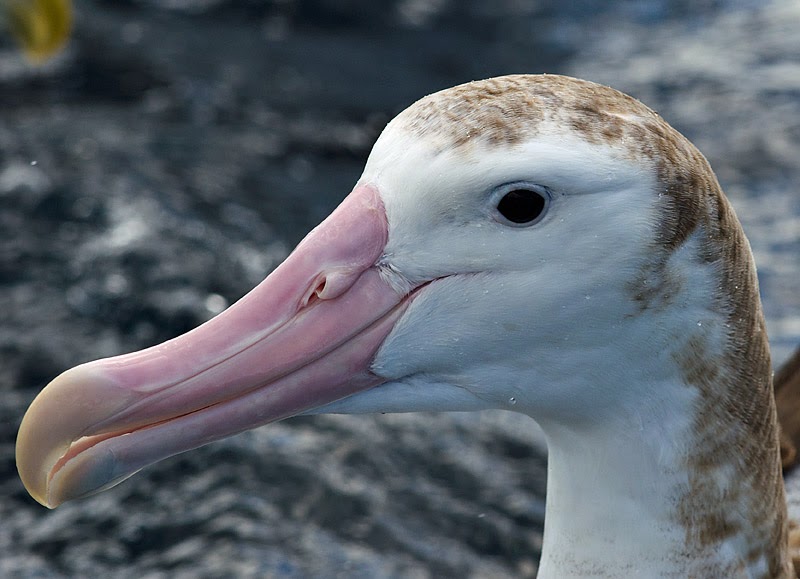
Great-winged Petrel's were not in particularly large numbers although they persisted throughout the time at the shelf. The majority were race macroptera with a few gouldi. A couple of juvenile Wandering Albatross gave us our 5th species (6th taxa) of the day, on the water these remind me of big clumsy geese but in flight they are something else!!

Smaller numbers of Great-winged Petrel's

As we moved to the second berley stop we had up to five Great Shearwaters following us which grew to six when we stopped and berleyed again. As I wandered back to get some food, the call came out "Gould's Petrel!!", I almost flew back but fortunately the bird stuck around and was eventually joined by a second. This was my second tick of the day and to be honest my favourite bird of the day!! The Great Shearwaters almost became a trash bird and would continually circle out, then fly back in causing momentary excitement when you see a large, pale bellied petrel coming in only to realise it is "just another Great Shearwater". As it turned out these were actually the most common pelagic shearwater of the day,even outnumbering the few Short-tailed Shearwaters which wandered by :-)
Five species of Albatross

Eventually we had to cruise back in where en-route we saw what was likely the 8th Great Shearwater of the day as well as many more White-faced Storm-petrels. The only new bird seen on the way back in was a very distant Brown Skua which was the first local for the year. Some Common Dolphins and a few more spouting whales which remained frustratingly distant.

Back in the harbour we were all pretty stoked from what was a great day out. The weather had been very kind and we had dodged all the threatening storms. The water had also been calm with no one sick. Have to really recommend the boat which was very stable, had a good crew and was catered like no other pelagic I have been on - plenty of food and drink!


The day was not done however... Rob had a Lewin's Rail stakeout at Fawthrop Lagoon right in town. 8 of us trooped down and sure enough out popped not only a lovely Lewin's Rail but also a Spotted Crake. What a great way to end the birding day before the long drive home....